Guide · Heritage Windermere
← Back to Guides
Here’s a small test you can run before you arrive. Say the word Gilpin to anyone who knows the Lake District well, and watch their face do something the other hotel names don’t make it do. Part of that is the cooking and the welcome — but part of it, whether they know it or not, is the name itself, which is older than the house, older than the family, and comes with a sword in it. Give us ten minutes with your feet up, and the word on the gate will never read the same again.
Because that name is everywhere out here, once you start looking. It’s on the hotel, obviously. It’s on a plantation of trees down the valley. It’s on a river — a proper river, on the maps, with a Wikipedia page. And every one of those Gilpins flows from a single story, eight hundred years old, about the most dangerous animal in Westmorland — a story that happened, if it happened at all, more or less exactly where you’ll be having breakfast.
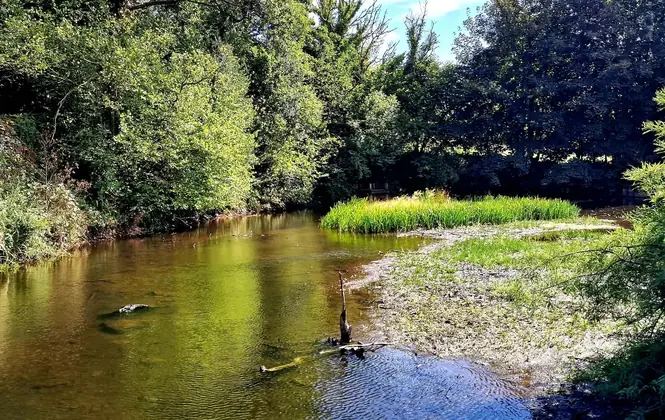
Walk the lanes around the hotel and somewhere in the first half-mile you’ll cross a beck — narrow enough to step over, busy after rain, minding its own business between the hedges. That unassuming trickle is the beginning of the River Gilpin. It rises here in the fields around Crook, gathers itself through Gilpinpark Plantation, and runs south down the Lyth Valley — the damson valley — to join the Kent on its way to the sea.
Rivers in this part of the world tend to carry the oldest names in the landscape: Kent, Leven, Brathay, all older than English itself. The Gilpin is the odd one out. It’s named after a person — and the person, so the story goes, earned it with a sword.
The legend runs like this. In the reign of King John — Magna Carta, Robin Hood, that neighbourhood of history — a wild boar of unusual size and thoroughly unreasonable temper took up residence in the forest between Kendal and Windermere. Its den was near Scout Scar, above Kendal. Its hunting ground was Crook and Cleabarrow — which is to say, the lanes outside your window. Pilgrims bound for the chapel on St Mary’s Isle in Windermere would stop to pray at Plumgarths before setting out on this stretch of road, and they were not praying about the weather.
Enter Richard de Gilpin, remembered as Richard the Rider. Tradition has him at the Baron of Kendal’s side at Runnymede for the sealing of Magna Carta itself — there as the baron’s secretary, the story insists, because the great man could neither read nor write. Which is a lovely detail, and tells you something about how these stories work: the pen first, then the sword. Because on his return, Richard did the thing nobody else would. He tracked the boar through the forest to its lair, fought it, and killed it.
And here is where the story fastens itself to this exact spot. Tradition places the boar’s end on the banks of the little stream you crossed in the lane — the stream that has been called the Gilpin ever since, after the man who won the fight beside it. The old inn half a mile along the road towards Kendal still carries the name of the loser. The Baron of Kendal rewarded Richard with the lordship of Kentmere, a whole valley of his own in the high fells, and the family put a black boar on their coat of arms and kept it there for centuries — the medieval equivalent of mounting the trophy above the fireplace.
Now, should you believe a word of it? The honest answer is that it’s legend: first written down long after the fact, polished by a ballad called The Minstrels of Winandermere, and quite beyond checking. But the river is real, the names on the map are real, and this is how the people of these valleys have explained them for eight hundred years. We’d call that a better pedigree than most facts have.
For most of its history this was simply good, quiet farming country — and when a house finally went up here in 1901, quiet was the whole point of it. Think about what that means for a moment. This was the height of the Lake District’s golden hotel age: the railway had reached Windermere half a century earlier, and anyone building with money and ambition built on the lake, with a terrace and a view and a jetty, to be seen. Whoever built this house did the opposite. They chose a fold of farmland off the Crook road, miles from the steamers and the crowds, wrapped in gardens and trees, where nothing passes but the weather.
Sound familiar? It should — it’s precisely what people book Gilpin for today. The A591 grinds along the lakeshore all summer; these lanes stay silent. A hundred and twenty-five years before “hidden gem” became a cliché, somebody stood in this field and understood exactly what would one day be the scarcest luxury in the national park. The house has been keeping that secret ever since.
In 1919, with the war just over, a woman named Harriett Cunliffe came to this corner of Crook — and the rest of this story belongs to her family. The lodge in its gardens and, a mile across the fields, a house beside a small private lake called Knipe Tarn: for the next half-century this quiet pocket of the south Lakes was Cunliffe ground. Her home was the house by the tarn, and the family’s photograph albums from the 1930s show exactly what you’d hope — gatherings on the water, children messing about in boats, the whole tribe descending on the Lakes for the summer.
One of the children who came later, in the years just after the Second World War, was her grandson John — a small boy spending his school holidays here with his grandmother. Hold on to that boy. The entire modern history of this hotel is what happened inside his head.
In 1968 the family’s time here ended, and the houses passed to other hands. And here the story produces one of those details that feels invented but isn’t: that very year, the grown-up John Cunliffe — now a young hotelier — was opening a hotel on the shore of Windermere, a few miles from his grandmother’s old front door. Close enough to feel it. Not his.
What followed was one of the great globe-trotting hospitality careers, and it reads like a novel. John had met Christine at catering college in London; his first job took him to the Waldorf Astoria in New York, and when the visa rules changed under her, their wedding was hastily arranged by telegram so she could join him. There followed London and the Café Royal; Cyprus, in the uneasy years before the invasion; Jamaica, opening a grand new hotel in Kingston; then back to London, where John ran banquets for the City’s ancient livery companies, the Guildhall — and Number Ten Downing Street.
His Downing Street years produced our favourite story in the whole saga. After one particularly crowded reception, the Prime Minister herself — Margaret Thatcher — confided to John that she was worried about cigarette burns in the carpet, since she considered herself the guardian of the house while she lived in it. And so the two of them got down on the floor of Number Ten together and crawled about hunting for stubs among the chair legs — and whenever she found one, she handed it to him. John’s verdict, delivered deadpan decades later: that, he said, was delegation.
He catered for the Pope at Coventry in 1982 — planned for seven hundred thousand, at which three hundred thousand turned up, a shortfall he cheerfully blamed for his fall from grace. He collected the Freedom of the City of London, which technically entitles him to drive sheep over London Bridge. Christine, meanwhile, was running the school meals service for an entire London borough — a hundred and twenty schools and six hundred staff — which may explain why nothing at Gilpin has ever frightened her since.
By 1987 the Cunliffes had left the corporate world and bought a small hotel of their own in Bath — and it was going wrong in every way a hotel can. The roof leaked. The American tourists it depended on stayed home. The accounts were chaos. And in the middle of all of it, Christine opened the trade press and found a small advertisement: Gilpin Lodge, Windermere, for sale.
Her reaction, as John later told it, was immediate and entirely unsentimental: get up to Windermere today. You’ve always wanted a hotel in the Lakes, and this one is in your blood. Get us out of this mess.
Now think about that drive north. A man in middle age, a failing business behind him, going to look at the house where he’d spent his childhood summers — the one his family had let go nineteen years before, the one he’d spent an entire career on three continents not quite forgetting. Within months, his grandmother’s Gilpin Lodge was his. Some people buy a hotel. John Cunliffe bought his way back into his own story.
The hotel that opened in 1988 bears roughly the same relationship to today’s Gilpin as an acorn does to an oak. Five bedrooms. Christine in the kitchen as head chef — the borough school-meals commander now cooking every dinner herself. Eighty-hour weeks, no holidays, and for a long stretch not even a proper home of their own, because every habitable room was needed for guests. This is the part of every great family hotel’s story that the glossy photographs skip, and it went on for years.
But it worked, and it grew, and it stayed stubbornly in the family as it did. Their eldest son Barney and his wife Zoë joined in 2001 and run it today. Their younger son Ben became an architect, and his practice has shaped the buildings — which is why the newer wings and garden suites feel of a piece with the place rather than bolted on: the architect grew up here. In 2006 came admission to Relais & Châteaux, the invitation-only club of the world’s finest small family-run hotels — the moment the wider world formally agreed with what the guests already knew.
And then, in 2010, the move that closed the circle. The house on Knipe Tarn — Harriett’s house, the one in the 1930s photographs, the rowing boats and the summer gatherings — became Gilpin Lake House: a retreat of its own with its own grounds and its own private water, a mile from the hotel. For the first time, the two estates the family had known since 1919 stood together under one name.
Stay at the Lake House today and you are sleeping in the founder’s grandmother’s home, looking at the tarn his father messed about on as a boy. Very few hotels anywhere can offer you a room inside their own family album. This one can.
John wrote the whole tale down eventually — a memoir called Slightly Perfect, which won its category at the Lakeland Book of the Year awards in 2020 and very nearly took the overall prize. He died that same year, and Christine followed in 2022, with the hotel they built together in the safe hands of the next generation — and the generation after that already appearing in the family photograph, the sixth of the family to belong to these two estates.
The hotel’s strapline, in case you spot it, is love and laughter — and even that wasn’t invented by a marketing agency. Two separate sets of guests, quite independently, told Zoë that this was what they thought of when they thought of Gilpin. The family simply agreed, and kept it.
As for the honours: the hotel holds two Michelin Keys — rare company anywhere in Britain outside London — and its flagship restaurant SOURCE holds a Michelin star. The two are judged entirely separately, which makes holding both rather the point. We’ve covered the whole picture in the Michelin Key hotels of the Lake District, and if you’re planning a day around a table at SOURCE, we’ve written that day for you.
There’s a pattern running through all of this, and once you spot it you’ll see it everywhere. The boar-slayer’s name sank into the land and never left — it came back on a river, a plantation, a lodge, a hotel. William Gilpin sent the travellers north, and they have been coming back every year since. Harriett’s grandson carried this place around the world for nineteen years and came back for it. The two estates drifted apart and came back together. Even the guests are in on it: ask anyone who works here and they’ll tell you the calendar is full of people returning — same week, same room, year after year.
That’s the thing you’re actually booking, whether you knew it or not. Not a lake view — the man who built this house in 1901 turned one of those down on purpose. You’re booking the quietest corner of the south Lakes and a story that has spent eight hundred years proving that people who find it, come back.
Have a marvellous stay. And when the fells a few minutes up the road start prompting questions of their own — we’re local, we collect at the door, and this is what we do.
A note on the boar: the story of Richard de Gilpin is legend, not documented history — it was first written down centuries after the events it describes, and no thirteenth-century record of the fight survives. The River Gilpin, Gilpinpark Plantation and the Gilpin family of Kentmere are all real, and the legend is how eight centuries of local people have accounted for them. We tell it as tradition, which is exactly what it is.
Lake District Tours is an independent, family-run tour company based in Kendal. This guide is not affiliated with or endorsed by Gilpin Hotel & Lake House.
Staying at Gilpin, or planning to?
The house was built in 1901 as a private residence, and stayed one for most of a century. It opened as a hotel in 1988, when John and Christine Cunliffe bought it with five bedrooms and began the family business that runs it today.
It takes its name from the River Gilpin, which rises in the lanes around the hotel — and the river is named, in legend, for Richard de Gilpin, said to have slain a wild boar that terrorised this stretch of country in the reign of King John. The hotel was known as Gilpin Lodge for most of its life.
The family's connection began in 1919, when John Cunliffe's grandmother Harriett came to this corner of Crook, and lasted until 1968. John and Christine Cunliffe bought Gilpin Lodge back in 1987 and opened the hotel in 1988. Their son Barney and his wife Zoë run it today.
A separate house on Knipe Tarn, about a mile from the hotel, with its own grounds and private tarn. It was Harriett Cunliffe's home from 1919, and in 2010 it opened as Gilpin Lake House — reuniting the two family estates under one name.
Both. The hotel holds two Michelin Keys, and its flagship restaurant SOURCE holds a Michelin star. The two are awarded independently of each other.
No — Lake District Tours is an independent local tour company based in Kendal, and not affiliated with Gilpin Hotel & Lake House. It just happens that the name on the gate carries our favourite legend in the south Lakes.