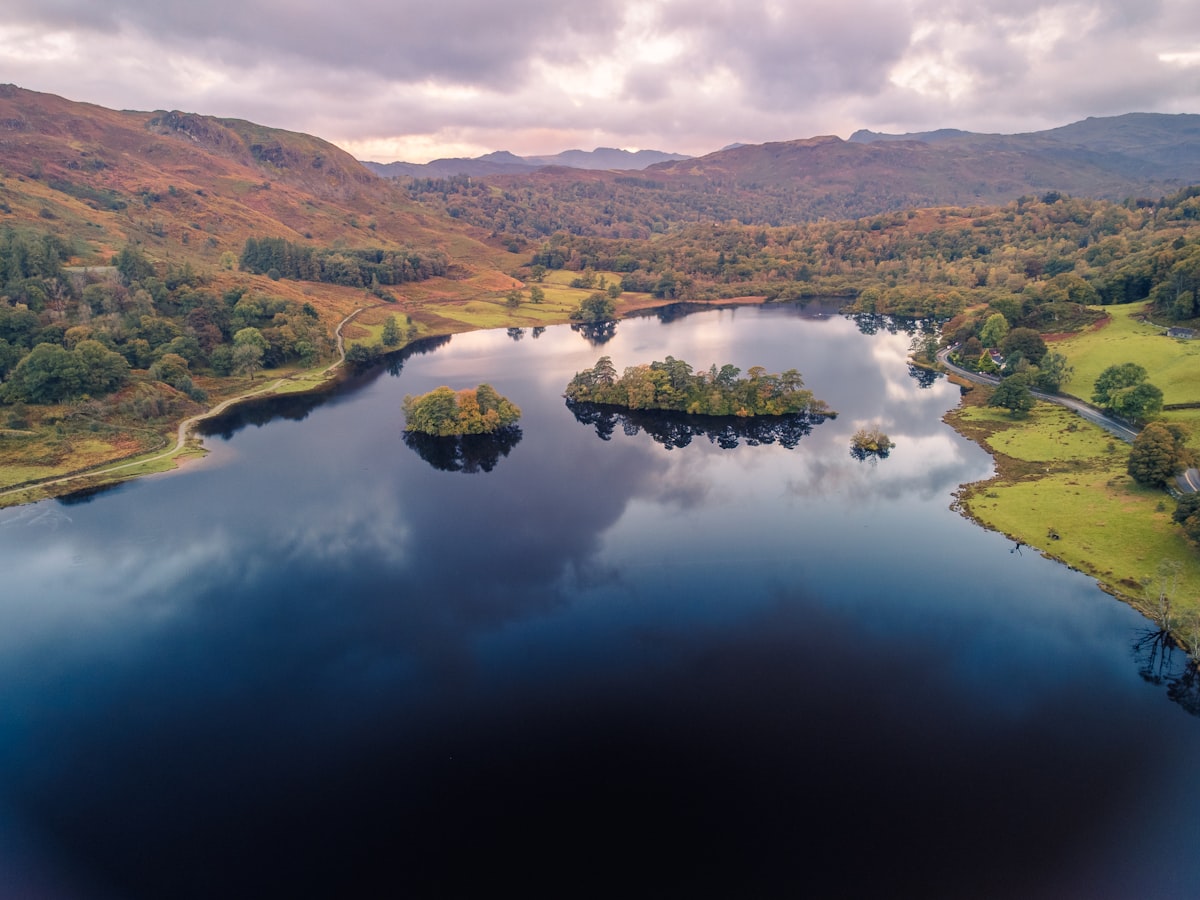
Some morning in the early 1800s — pick any year from 1800 to 1808, the story holds for all of them — a man in his thirties walks out of a small cottage on the edge of Grasmere and turns south. He goes down past Rydal Water, through Ambleside, and out along the road above Windermere’s eastern shore: five miles or so, which to him is nothing, because he may be the most relentless walker in the history of English literature. Above the lake he turns in at a gate, climbs a steep little drive to a white house looking down the water, and hands over money.
The walker is William Wordsworth. The cottage behind him is Dove Cottage, where he is writing the poems that will fix this landscape in the world’s imagination for good. And the money is the rent — because the man who built the house you are staying in was his landlord.
John Benson was not an incomer with a fortune to spend. His family had been in the Windermere district since the fifteenth century, and by the time he built this house, about 1780, he was a substantial local landowner with property scattered across the area. He chose his own spot with some care: a shelf of hillside above the eastern shore, high enough for the view to run away down the length of the lake, tucked enough to be private. He called the new villa Dove Nest, and a document of 1782 already places him living in it.
Every guest since has been enjoying his judgement. The house has been extended, renamed and reinvented, but the one thing nobody has ever needed to improve is where he put it.
Among Benson’s many properties was a former inn at Town End in Grasmere, converted into a modest cottage. In December 1799 he let it to a young poet and his sister, and for the next eight and a half years the tenant of what we now call Dove Cottage was William Wordsworth — through the Lucy poems, the daffodils, and most of The Prelude. When rent fell due, Wordsworth came here, to the landlord’s own door.
It is worth pausing on how good that walk was. Five miles down the spine of the district, with Rydal Water and then Windermere opening on his right hand — a commute through the exact scenery he was busy making immortal, to settle the bill on a cottage that now receives visitors from every corner of the world. Whatever the rent was, it has proved excellent value.
Benson died in 1808, and his widow Agnes made a decision that shaped the next hundred and fifty years: rather than sell, she let the house to wealthy tenants. It never stopped being let. William Green’s guidebook of 1819 could already reel off the succession of gentlemen who had taken it, noting that one of them, Edward Pedder, had “greatly improved” the place, and that the house “commands a very interesting view down Windermere” — a sentence which has needed no updating in two hundred years.
Pedder’s household left something better than improvements. Between 1809 and 1812 the family employed a governess called Ellen Weeton, a sharp-eyed Lancashire woman who wrote everything down. Her journal, finally published in 1936 as Miss Weeton: Journal of a Governess, is one of the most vivid first-hand records of a governess’s life in Georgian England — and a good stretch of it happened in this house. The grand tenants came and went; it is the employee we can still hear talking.
Then came the tenant the house is quietly famous for. In the summer of 1830, Felicia Hemans rented Dove Nest with her sons. If the name has faded, her lines have not: “The boy stood on the burning deck” is hers, and in 1830 she was one of the best-selling poets in the English-speaking world — read in every parlour in Britain and America. She was also a friend of Wordsworth, by then sixty and living at Rydal, a short ride up the road.
He visited her here constantly. Her letters from that summer describe an old-fashioned alcove in the garden, the sweetbriar and moss roses run wild around it, where he would read aloud:
I look down from it upon lovely Windermere, which seems at this moment even like another sky… It is quite a place in which to hear Mr. Wordsworth read poetry.
One evening, after a ride through Grasmere, their talk turned to the sounds of the valley at dusk, and she wondered aloud whether there might be music in nature pitched too deep for human ears. Wordsworth answered by reciting Milton — “Millions of spiritual creatures walk the earth / Unseen, both when we wake, and when we sleep” — in a voice she said rose and fell like a breeze. The Hemans family were so taken with the house that they had an engraving of it made, and printed it on the title pages of her books: for a while, this hillside travelled the world as her frontispiece.
There is still a Georgian arbour in the gardens, looking down on the water. Whether it is the very alcove she wrote from, nobody can prove — but sit in it on a still evening with Windermere below, and the case rather makes itself.
The Bensons kept collecting the rent for another century. Thomas Benson, who had let the house to Mrs Hemans, died unmarried in 1869; a relative, another John Benson, came from Colton to live out his days here; after his death in 1876 the estate passed into a family trust, and the letting simply carried on. A Volunteer officer and his wife took the house for decades either side of 1900. After them came Alfred Illingworth, a well-known sportsman and angler, whose wife Emily died in 1923 — two years later he gave Kelsick Scar, above Ambleside, to the National Trust in her memory, and the plaque is still up there on the crag.
The trust wound down around 1960, and with it ended one of the quieter records in the district: a single family holding a single house for the best part of two centuries, and in all that time hardly ever living in it themselves. The Bensons built a view, and then let England’s writers, soldiers, merchants and anglers take turns at it.
The modern chapter is brisk by comparison. In 2002 the house opened as a hotel under a new name: The Samling, an old Cumbrian dialect word for a gathering — the relaxed restaurant in the converted barn is called The Gathering as a nod to it. A complete renovation followed in 2017, and the estate around the house — 67 acres of orchards, hay meadows, beehives and spring-fed water gardens threading down the hillside — was brought on rather than tamed.
Today the hotel holds two Michelin Keys, Michelin’s second-highest distinction for a stay, at a size of about twelve rooms — and the restaurant holds a Michelin Star in its own right, the two awarded independently of each other. There is more on what that pairing means, and how rare it is, in our guide to the Michelin Collection.
And through all of it, one small door has never been repainted: on the National Heritage List for England, the Grade II entry for this building is still registered under its original name. Officially, you are staying at Dove Nest.
Which brings the story to you. For two hundred and forty years, almost nobody who slept in this house actually owned it — not the poet at the door with the rent, not the governess writing by candlelight, not Mrs Hemans in her arbour. It has always been a house you take for a while: the view held by one family, and lent out, a tenancy at a time, to whoever could appreciate it.
Your tenancy is the shortest on record. It is also, by a comfortable margin, the best deal anyone here has ever had — the same view Wordsworth walked five miles to visit, with the garden at its peak, and dinner cooked to a Michelin Star downstairs. The rent book closed decades ago. The arrangement, somehow, survives.
We are an independent local tour operator. This guide is not affiliated with or endorsed by The Samling.
Staying on this hillside, or planning to?
Dove Nest. The house was built about 1780 by John Benson and kept that name for over two centuries — it became The Samling when it opened as a hotel in 2002. Its Grade II listing is still registered under the original name.
The house was built by John Benson, who owned Dove Cottage in Grasmere and was William Wordsworth's landlord there from 1799 to 1808. Wordsworth walked the five miles or so from Dove Cottage to this house to pay his rent.
Felicia Hemans was one of the best-selling poets of her age — 'The boy stood on the burning deck' is her opening line. She rented the house in the summer of 1830, and Wordsworth visited her here often; her letters describe him reading poetry aloud in an arbour in the garden, looking down on Windermere.
It is an old Cumbrian dialect word for a gathering — the hotel's relaxed restaurant in the converted barn is called The Gathering as a nod to it. The name was adopted when the house became a hotel in 2002.
Yes — two Michelin Keys for the hotel, and the restaurant holds a Michelin Star in its own right. The two are separate distinctions, awarded independently. There is more in our guide to the Michelin Collection.